Thursday, April 10, 2014

The Miracle Birth of a Kakapo Parrot

If you haven't had your daily dose of cuteness yet, just click the video below to see a rare baby parrot!

For those unfamiliar with the Kakapo parrot - the Kakapo is a critically endangered bird in New Zealand. Currently, Kakapo live on protected islands that are kept predator-free. As of earlier this year, there were only 124 of these birds in the entire world, so each and every member is vitally important to the species. Each Kakapo is equipped with a tracking device, and they all have names given to them by conservation workers.

Kakapo only breed every 3 - 5 years, so the recovery is slow (but steady). This year, 2014, six new babies have been added to the population, which brings the total to 130. However, one of them almost didn't make it when Lisa, the mother Kakapo, accidentally crushed the egg. Fortunately, the Kakapo Recovery team has staff and volunteers who monitor nests, and they discovered the condition of the egg. The membrane looked okay, so the team was able to take the egg and repair it with tape and glue. They weren't sure if the chick had survived, but it was certainly worth a try!

Their efforts were rewarded several days later on February 28, when a new Kakapo joined the world to be the first new baby since 2011. The chicks are temporarily named after their mothers, so for now, this baby is called "Lisa One." The above video (posted on the Kakapo Recovery team's Youtube channel) shows Lisa One at a few days of age. As of early April, the chick is growing well, and is starting to show the green feathers of an adult Kakapo.

For more updates (and to find out how you can help in the recovery efforts), check out the official Kakapo Recovery website at: http://kakaporecovery.org.nz/

Thursday, November 28, 2013

Turkeys Purr

Photo by: Dimus, released by author to Public Domain (via Wikimedia Commons)
It's Thanksgiving in the United States, and many people are having turkey for dinner. When we think of sounds turkeys make, the gobble is usually the first one that comes to mind. We're most likely to hear gobble sound effects on television and radio in November, even though turkeys do most of their gobbling in spring during the mating season (it's how males announce their presence to females and to other males who may be encroaching on their territory). Even though the gobble is the most famous turkey sound, turkeys have a richer vocabulary. They also cluck, yelp, cackle, and perhaps most interestingly, they purr.

Unlike the gobble that can be heard from hundreds of yards away (it's said that it can sometimes even be heard from a mile away), the purr is a soft sound that can only be heard when close to the turkey. It doesn't sound quite the same as the purr of a cat, but it does sound a little like a cat's "trill." Click here if you'd like to hear it.

Both male and female turkeys purr, and they purr for one of the many reasons cats do - it's often a sign of contentment. Turkeys will also make the sound when eating, as a way to let each other know the fellow members of the flock are there (since they can't see each other very well when their heads are down picking up food).

There are a couple of variations to the purr. Sometimes turkeys will make a "cluck purr" when contented or when communicating with others in their flock. However, another purr has a completely different meaning. Turkeys will also purr when fighting! A turkey's fighting purr is louder and more continuous than the contented or communicating purr. Gobblers (males) aren't the only ones that fight-purr. Hens will do it as well if they're annoyed at another turkey.

Thursday, October 31, 2013

PSA - Watch Out for Killer Hornets

Asian Giant Hornet (Photo by: Thomas Brown, via Wikimedia Commons, CC BY 2.0)

Back in the 1980s, the world was abuzz about killer bees (officially called "Africanized bees"). Last year, the existence of zombie bees was brought to the attention of the public. Now, somewhat reminiscent of the fictional genetically-engineered tracker jackers from the Hunger Games, we have killer hornets to worry about.

First though, if you happen to come across an article or receive an email saying that giant hornets are mutants created due to radiation exposure from the Fukushima power plant - and that they're killing people in Nebraska - that is false. However, the Asian Giant Hornet (Vespa mandarinia) does exist, and it can be deadly.

True to their name, these are LARGE hornets that live primarily in Asia. They are especially found in Japan, where they are also known as the Giant Sparrow Bee. These insects are about 2 inches long with a 3 inch wingspan. Their stingers are about a quarter of an inch long. As one might imagine about such a large hornet, the sting is quite potent. It has been described as feeling like a hot nail, and the venom contains a neurotoxin and can cause renal failure. Unless you're allergic, a few stings likely won't kill you, even though they will be quite painful and will leave a substantial wound behind. However, if somebody is unlucky enough to receive 10 stings, they should seek medical attention right away. (Of course, an allergic person needs help for any sting).

This year, the hornets have been more aggressive toward humans than usual. Just in China, they killed at least 42 people between July and the beginning of October, and injured over 1,600.

It's not just humans who are at risk from the Asian Giant Hornet. These predatory insects go after other hornets, mantises, and honey bees as well. They use their mandibles to decapitate their victims, and just a few hornets can destroy an entire honey bee colony in a few hours. Not all bees are defenseless, though. If a hornet scout happens upon a Japanese honey bee colony, the bees form a ball around her. They use their muscles to heat the inside of the ball, and they breathe out carbon dioxide. A few bees die, but the heat and CO2 also kill the hornet, which prevents her from summoning others to the hive.

Friday, October 11, 2013

Keep Your Bird Feeders Stocked Through the Winter

Chickadee on a bird feeder (own work)

Some well-intentioned people operate under the misconception that all birds head south for winter. I live in the northern half of the US, and while shopping at my local grocery store last fall, I noticed a display of bird food and bird feeders. I stopped to check them out (my old feeders were due to be replaced). While I was examining a feeder, a young boy and his grandfather walked by. I overheard the boy ask if they could get a bird feeder, and the grandfather said (loudly, as if he was making sure I could hear), “Why would anybody buy a bird feeder this time of year? The birds are all going south!”

Another time, once again in fall, I was having a chat with a former co-worker about backyard birds. When the topic of feeding them came up, he said, “That reminds me. It’s about time to take the feeders down for the winter.”

Actually, as I explained to my co-worker, winter is a great time to feed the birds, even for those who live in more northerly latitudes. While it is true that some birds do in fact head south when the weather starts cooling off, quite a few stick around. Blue jays, cardinals, mourning doves, chickadees, finches, titmice, and sparrows are just some of the birds who are year-round residents. There are even some birds that migrate to the northern US from even further north. I always know winter is almost here when I see dark-eyed juncos hopping around in my backyard.

Food sources for these birds are scarcer in winter than they are during warmer months. Plants aren’t growing and producing new seeds or fruit, and most insects are dead or dormant. If you keep your feeders stocked, you’ll be sure to draw a crowd! I have a few birds who are regular visitors to my yard in summer, but my feeders are a bustling center of bird activity in winter. I also see a much wider variety of birds when it’s cold.

If you decide to offer food in winter, higher fat foods are best. They are higher in calories, and birds burn off a lot of calories just trying to stay warm. Sunflower seeds, safflower seeds, peanuts, and suet are good choices for most birds. If you’re not squeamish about it, you can also offer dried mealworms and insects. Just keep in mind that suet, peanuts and sunflower seeds are likely to draw squirrels and other critters as well. It’s said that squirrels don’t care for safflower, but that seems to vary by region.

Thursday, October 3, 2013

Only Two Bat Species Can Walk

Vampire Bat (Photo by: Ltshears, via Wikimedia Commons, CC BY-SA 3.0)
Whenever we see bats in photos, videos, or even in real life, they are almost always flying or hanging. If you visit a nature center and see a program about bats (or if a bat program comes to your school), you'll usually see them being held in a demonstrator's hand. We almost never see them walking. It turns out that the reason for that is simple - most bats can't walk.

Bats are the only mammals that can fly, and they are extremely specialized for this skill. Their bodies have an aerodynamic shape, their bones are light, and their wings are thin, flexible, and hypersensitive. In fact, their wings have almost two dozen joints, and are covered with Merkel cells, which are the touch-sensitive cells found on our fingertips.

Unfortunately, most bats' rear legs are more or less useless for anything except hanging. They are very thin and weak with fragile bones. Their knees also face backwards. If a bat ends up on the ground, he'll use his front limbs to clumsily drag his body while keeping pressure off the back legs. This can be awkward, since the front limbs are meant for flying rather than crawling.


However, out of the over 1,200 species of bat, there are two species that actually can walk - the vampire bat and the burrowing bat (also known as the lesser short-tailed bat). In fact, a laboratory study using treadmills showed that vampire bats can even sprint on all fours. They primarily use their front limbs, and can even reach speeds of 2.7 miles per hour. That may not sound very fast to a jogger or power walker, but it's definitely respectable for a small animal that's more equipped for flight.

The burrowing bat has adaptations conducive to walking - claws at the base of their toes, grooves on their feet, and elbow joints that bend sideways and allow them to use their wrists to push off. Burrowing bats take advantage of these traits to forage for food on the ground as well as in the air.

Monday, September 30, 2013

What's the Difference Between a Raven and a Crow?

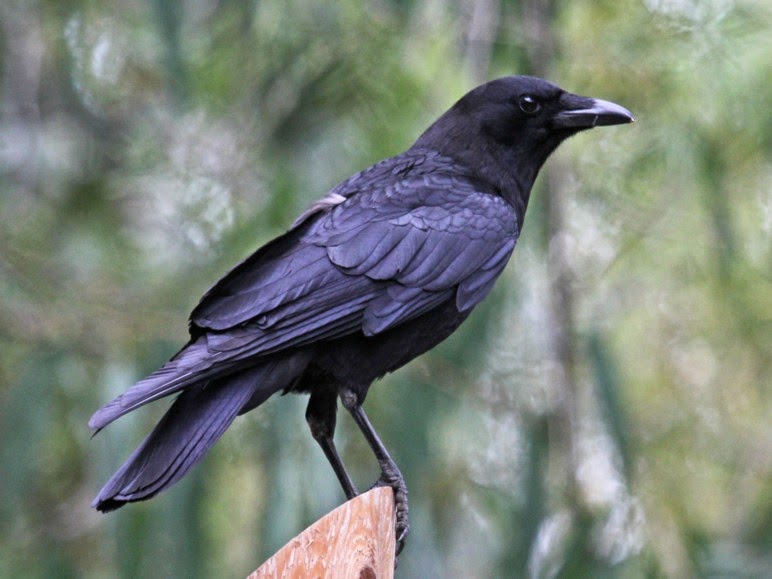
American Crow (Image by: DickDaniels, via Wikimedia Commons, CC BY-SA 3.0)

Many people see a rather large black bird and assume the bird is a raven. Or a crow. Some people assume ravens and crows are the same type of bird. That's understandable, since they look similar at first glance. To make things more confusing, both birds belong to the crow (corvus) family, and any member of that family can be called a crow. That means a raven could be called a crow, but not all crows could be called ravens. What's the difference between a raven and a crow?


Technically speaking, a crow is any bird from the genus, corvus. However, the word "crow" is most often used to refer to just a few specific species. In North America, it usually refers to either the American Crow or the Northwestern Crow. In Europe, it usually refers to the Carrion Crow or the Hooded Crow. Most crows are black in color (however, the Hooded Crow is mostly grey), have a wingspan of around three feet, and are around 18-21 inches in length, depending on the particular species. They eat almost anything - fruit, nuts, carrion, eggs, small rodents, amphibians, scraps from garbage, etc. They tend to hang out near humans so they can scavenge. Crows are very intelligent, and are often regarded as some of the world's smartest animals. They make many vocalizations, and are great mimics.

Common Raven (Image by: David Hofmann, via Wikimedia Commons, CC BY 2.0)


Most sources will tell you that one of the main differences is that ravens are larger than crows. While this is usually true, it isn't a fool-proof way of telling the birds apart. The Common Raven is generally between 22 and 30 inches in length, and as mentioned above, crows can be as large as 21 inches. Therefore,a large crow can easily be mistaken for a small raven (and vice versa) if you only go by size.

Even so, there are other physical differences you can look for. A raven's feathers are shinier and usually "fluffier" (or appear fuller) than a crow's. A raven's bill is larger and curved closer to the end than that of a crow. Ravens have a slight point in their tail which gives it a wedge shape, while a crow's tail is more rounded. Ravens also look a bit different in flight. They have longer, thinner wings and are likely to be seen soaring. If you see a black bird doing a somersault in the air, you're looking at a raven! If you hear its call, you can usually figure out which bird it is - a crow has a distinctive "caw caw" sound, and a raven's call is deeper and more of a croak. Ravens are also less social than crows and are more likely to live in less populated areas or in parks, though they can adapt to most environments.

Ravens and crows aren't completely different, however. The similarities in appearance are obvious, and both birds have demonstrated problem-solving skills in laboratory experiments and in the wild, which puts them both toward the top of the avian intelligence ladder. They eat similar diets - they are both opportunistic omnivores, even though ravens seem to prefer carrion a little more than crows. Of course, one of the main things crows and ravens have in common is that they are both awesome and fascinating birds.

Wednesday, September 25, 2013

Elephant Poachers are Poisoning Vultures

Rueppell's vulture (Photo by: Hans Hillewaert, via Wikimedia Commons, CC BY-SA 3.0)
Here's another entry for the "reasons why people suck" list.

Elephant poaching has been a problem for a quite some time. Poachers kill these majestic beasts primarily to harvest their ivory tusks to sell illegally. The tusks are made into trinkets, which are seen as status symbols in some parts of the world. Elephant hides are also sometimes taken and sold. Rhinos are being poached as well for their horns, which can be carved into objects or used in traditional medicine. Even though trade of ivory is restricted, demand through illegal ivory networks is rising, and poaching is getting worse.

Poaching these animals is bad enough. However, to make things even worse, elephant and rhino poachers are also killing off vultures. Why are they harming these birds? As most people know, vultures eat dead animals. When something as large as an elephant dies, you'll find many vultures gathering near the carcass to partake of the feast. Police and wildlife officials use this behavior to their advantage. They can follow the vultures to track the poachers.

Unfortunately, these poachers have no respect for lives other than their own (if they did, they wouldn't be poaching), and the vultures threaten their "businesses." To try to kill off the informers, the criminals poison the elephant and rhino carcasses. When the vultures, who are just looking for something to eat, consume the meat, they die. The poachers hope to eliminate the vultures in the areas they operate. Sadly, these lawbreakers don’t seem to realize that vultures travel huge distances to find food, so it’s impossible to get rid of vultures in a particular zone. Or maybe they do realize it and are fine with playing a huge part in the extinction of these birds.


This past July, there was a poisoning incident in Namibia that killed 600 vultures. This just adds to the list of problems vultures in Africa have been facing for decades. Thanks to habitat loss, predator poisoning from farmers, and the use of veterinary drugs that are deadly to birds, vulture populations in West Africa have declined by 42% in the last 30 years. One species, the Rueppell’s vulture, has been hit particularly hard, with an 85% decline.

New Direction for the Blog...

I live! I also want to do something with this blog again. I originally started it about a year and a half ago as "Animal Fact of the Day." For about a month or so, I was pretty good about posting some sort of animal fact almost every day. However, I soon learned that I had bitten off more than I could chew. Trying to come up with a new and exciting animal fact to write about every day became quite a challenge. I was stressing out over keeping things interesting and fun, and about keeping the content coming. It became a "something I still have to get done today" chore as opposed to something I enjoyed doing. I was starting to burn out, and fast. It didn't help that I went back to work and also started taking classes, both of which took up a lot of my time.

In any case, I've recently started to miss writing about animals. However, the idea of trying to come up with daily animals facts again is still as daunting as ever. Therefore, I've decided to give the blog a bit of a makeover. Animals will still be the main topic, of course. However, posts will cover animal facts, news, and just random basic information. They also won't come every day. I'm thinking maybe one or two posts per week, on average. I could have a particular productive week in which I become inspired to write more, but I doubt that will be a regular occurrence.

Anyway, say goodbye to "Animal Fact of the Day," and hello to "Animal Facts, News, and Info."

Wednesday, October 3, 2012

Watch Out for Zombie Bees

Maciej Czyżewski, CC-BY-SA-3.0,2.5,2.0,1.0, via Wikimedia Commons

"Zombie bees" (aka zombees) are showing up is some parts of the United States. Don't worry, they aren't coming after our brains. The poor critters are infested with a parasite.

Apocephalus borealis, a fly known as the "scuttle fly" or "zombie fly", is the culprit. This insect has been known to infect bumble bees and paper wasps in the past, but now it is also using honey bees as hosts. The adult fly lands on the bee's back and injects the eggs into the abdomen. The eggs hatch, and the maggots eat the bee from the inside while they grow. Once a bee is infected, it will abandon the hive at night and fly around erratically in movements reminiscent of a zombie. This goes on until the bee dies and the maggots crawl out to pupate. 

As of October 3, 2012, the problem is primarily in California, where the bees were first discovered in 2008. However, confirmed cases of infection have also been confirmed in Oregon and Washington State, and as far east as South Dakota. The flies themselves have been found scattered across the United States and Canada, all the way to the east coast.    

The honey bee has been a victim of unexplained die-offs around the world in recent years. Bees are also susceptible to a variety of other parasites, bacteria, fungi, and viruses. The zombie fly is yet another threat to populations of one of our most important pollinators.

You can find updates on the spread of the infection at ZomBee Watch.

Monday, October 1, 2012

Some Pets Can Contract the West Nile Virus

Electron Micrograph of West Nile Virus (CDC Image, via Wikimedia Commons, PD-USGov)
2012 was a record year for the West Nile virus. We already know that this virus is zoonotic, which means it can pass from animals to humans, and from humans to animals. What does this mean for our furry, feathered, and scaly friends?

West Nile Virus in Cats and Dogs
There are two ways a dog or cat could possibly be exposed to this disease. He may be bitten by an infected mosquito, or may decide to snack on an infected prey animal such as a mouse. That being said, dog and cat owners can relax a bit. The West Nile virus doesn't seem to cause much harm to our two most popular pets. In an experiment, cats and dogs were intentionally infected with the virus (yeah, I'm not crazy about that either). The dogs and some of the cats didn't show any symptoms, and the rest of the cats experienced only mild symptoms such as lethargy and a slight fever. (You can read the report here, but I recommend stopping after the abstract if you're a cat and/or dog lover).

Even though WNV probably won't harm the health of your cat or dog, if you notice any suspicious symptoms, contact your veterinarian. He or she can provide supportive care for your pet if necessary.

Reptiles and Amphibians
Studies have been done with iguanas, garter snakes, bullfrogs, and turtles (specifically, red-eared sliders). In one experiment, the iguanas, snakes, and bullfrogs became infected, but none exhibited symptoms. In a different study involving only garter snakes, 4 of 9 snakes died. Young crocodiles and alligators seem to be the most susceptible to WNV - there have been outbreaks of the disease among wild alligators in multiple states. Also, there have been transmission studies that strongly suggest the virus can pass directly from an infected alligator to tankmates. Symptoms to watch out for are "star gazing" and mouth lesions.

Horses
There's good news and bad news for horse owners. First, the bad news is that horses are susceptible to the WNV. Most horses that get bitten do not get sick, however, those that do get sick show symptoms of encephalitis such as loss of appetite, depression, weakness, muscle twitching, paralysis, convulsions, or coma. The good news is that vaccines are available for horses. Vaccination is obviously your best protection, but other ways to reduce your horse's risk include: keep your horse inside during peak mosquito times, set up fans in the stable to help keep mosquitoes out, eliminate standing water, and check the property frequently for dead birds. If you do find a dead bird, call your local health department, and of course, never touch a dead wild animal with your bare hands.

Small Mammals (Pocket Pets)
Many small mammals have been experimentally infected with WNV. Mice, rats, and hamsters developed clinical signs (some severe). Guinea pigs and rabbits, however, did not become sick.

West Nile Virus in Pet Birds
Wild birds are the primary hosts of the West Nile virus. Crows, jays, thrushes, chickadees, and raptors are among the most affected. The virus has been reported in approximately 300 species of birds, so as one might guess, pet birds can become infected as well. Fortunately for parrots and their owners, psittacines seem to have at least some resistance. However, there have been a few cases in parrots such as macaws, cockatoos, conures, budgies, and cockatiels, so no bird is 100% safe. Some birds with the virus experience weight loss, weakness, fluffed feathers, or neurological symptoms such as paralysis, lack of coordination, circling, or seizures. Other birds experience no symptoms at all. For some, the only symptom is sudden death.

Officially, there is no vaccine available for birds,* and you should never use insect repellents on or near your bird due to the fact that birds are much more sensitive to chemicals than we humans are. So, how do you protect your birds? If your birds are indoors, they are pretty well protected as long as you keep your doors and windows closed (or screened) to avoid letting mosquitoes into the house. If your birds are in an outdoor aviary, you may wish to consider bringing them inside during peak mosquito times. If that's not possible, you can try using mosquito netting, and of course, make sure there's no standing water nearby.

As always, if you notice any symptoms, contact your veterinarian.

*Some zoos are using the equine WNV vaccine on their outdoor birds, and are experiencing some success with it. However, the vaccine has not been officially approved for birds as of yet.

Saturday, May 19, 2012

Those Scary-looking Anglerfish With the Big Teeth are Female

Public Domain Image (PD-1923) via Wikimedia Commons
This deep sea fish may be familiar due to its appearance in Finding Nemo, as well as its appearance on almost every list of "the world's ugliest animals." However, you're not likely to see one in person. Seeing a male deep sea anglerfish would be even less likely, and if you did see one, you probably wouldn't know it. When it comes to the humpback anglerfish (the kind in the above drawing) and "sea devils," the fishing lure and huge mouth full of teeth belong only to the females.

You may wonder where the males are. Well, you'll usually find them connected to the body of the female. When a male angler becomes sexually mature, his digestive system stops working. His options are then to either die of starvation, or find a female and join with her as a parasite. Neither option is a great one for the poor male. When he finds a female, he bites her, and then his mouth dissolves into her body. Their blood vessels merge, and over time, the male's organs are absorbed until the only things left of him are his gonads. The female can then use them when she wants to spawn, and she can end up with up to six "males" attached to her.

As far as the lure and giant teeth: the female uses her lure like a human angler would - to draw her prey (other fish) close enough for her to snatch with those teeth. The teeth are angled inward to help keep the prey from escaping, and her jaw and body are pliable enough to allow her to eat prey twice her size.

(Apologies for the lack of updates lately. My classes are starting to take up most of my time. I'll post again soon... I promise!)

Thursday, May 17, 2012

The Blue-Footed Booby Has Multipurpose Feet


Sula nebouxii - 06
Photo Credit: Maros (via Wikimedia Commons)
The Blue-Footed Booby is a bird with feet that are made for more than just walking. Like most seabirds, his feet are webbed and work as paddles for swimming and diving. On the downside, the web shape makes the bird clumsy as he walks on land, which is where his funny name came from ("booby" comes from the Spanish word "bobo," which means "stupid" or "clown"). Even so, the male blue-footed booby is quite proud of his feet, and he uses them to help attract a mate.

As one may guess from this bird's name, the feet are often blue in color. However, the color actually ranges from bright green to dull blue. When the male is ready to attract a female, he will perform a courtship dance full of struts and high steps - all moves meant to show off his feet. Studies have shown that females tend to prefer bright green, and that the color is dependent on the amount of carotenoids in the diet. Therefore, it seems the color is an indicator of the booby's nutritional condition (and suitability as a mate). 

The blue-footed booby has one more important use for those feet. These birds do not have brood patches (a bare patch of skin on the bird's belly for sitting on the eggs), so they use their feet to keep the eggs warm. The parents will continue using their feet to keep the babies warm even after hatching, as the chicks are unable to control their own temperatures for about the first month of life. 

Tuesday, May 15, 2012

A Cheetah's Speed Has a Downside


Gepardjagt1 (Acinonyx jubatus)
Photo Credit: Marlene Thyssen (via Wikimedia Commons)
We all know the cheetah is one fast cat. They can go from 0 to 60 miles per hour in a little over 3 seconds, and can reach speeds of 70 miles per hour, making the cheetah the fastest land animal. Watch a cheetah run and you can't help but be impressed. Their stride can be as long as 25 feet, and at top speed, they can make 3 strides per second. Unfortunately, this amazing speed has a downside for the cheetah.

A cheetah is literally built for speed - their bodies are aerodynamic in shape, they have huge hearts for pumping lots of blood, large lungs and nostrils, a flexible spine, and a long tail that can act as a rudder and counterweight to keep the cat steady as he runs and turns. This sounds great for the cheetah, but it turns out that running is practically the only survival skill he has.

The cheetah weighs an average of 125 pounds, which is small for a big cat. When the cheetah runs at top speed (which he can only do in a short burst), the heart pumps so hard and the body becomes so hot that brain damage can occur if the cat doesn't rest before eating. During the rest period, other predators or scavengers can come in and steal the prey, and there's nothing the cheetah can do about it. The cat is exhausted, and due to his aerodynamic shape, he doesn't have the muscle mass or strong jaws and teeth needed to fight back. All he can do is run.

Some people believe the overspecialization is part of why the cheetah is endangered, but most researchers believe the primary issue is the usual human created problem of habitat loss, along with loss of genetic variation. Fortunately, groups such as the Cheetah Conservation Fund are working to make sure this beautiful cat survives. 

Sunday, May 13, 2012

Elephants Make Great Mothers (and Grandmas, Aunts, Sisters and Cousins)


African Bush Elephants
Photo Credit: Gorgo (via Wikimedia Commons)
Yesterday, we talked about how alligators are great moms. On Mother's Day, we'll talk about another great mom from the animal kingdom - the elephant.

Female elephants have a complex social structure which is centered around the raising of offspring. When a young female reaches the age of around thirteen, she'll go into her first estrus. In other words, she'll be "in heat." This phase only lasts a few days, and will be one of the only times an adult male elephant is involved in a herd (males are usually solitary once they come of age). After mating, the female will carry the baby for 20 - 22 months. When the mother goes into labor, the entire herd will surround her and stand guard while she gives birth to a 150 - 220 pound calf. The herd will then greet the newborn, who is born practically blind and with few survival instincts.

Over the next two years, the calf will be dependent on her mother for food. She will survive completely on her mother's milk for the first few months of her life, and will drink about 10 quarts (about 9.5 liters) every day, which is enough for her to gain 30 pounds a week. The calf will start eating on her own at around age two, but mother's milk will still be a part of her diet.

The mother isn't the only one who takes care of the baby. The rest of the herd, which will consist primarily of related females (with some male calves) will aid in protection, teaching survival skills, helping out if the baby falls or gets stuck, and so on. 

If the calf is a female, she will remain with the herd once she becomes an adult (if the herd becomes too large, some of the elder females will break off and start their own herd). If the calf is male, he will head out on his own at around the age of sixteen.

Happy Mother's Day!

Saturday, May 12, 2012

Female Alligators are Great Mothers


Alligator Baby
Photo Credit: William Stamps Howard (via Wikimedia Commons)
When we think of animals that are good parents, reptiles usually don't come to mind. We tend to think that reptiles aren't very maternal - that they lay their eggs and move on with their lives. However, alligator mothers are some of the best moms around! (With babies as cute as the ones in the picture, how can they not be?)

A female alligator will begin breeding when she is between 7 and 12 years old. Males and females come together to mate in spring, and once the deed is done, the female will search for a place to build a nest. She will gather reeds and other plants to create the mound shaped nest, which will be about 3 - 3.5  feet tall and 7 feet wide. Then she'll lay between 20 and 60 eggs and will cover them up. She'll let the heat from the vegetation in the nest keep the eggs warm (being huge and cold-blooded, she doesn't sit on the eggs to warm them with her body like a bird would). 

The mom remains on guard near the nest for a little over two months while the eggs incubate. The babies chirp as they hatch, and when the mom hears the sound, she'll uncover the nest. If any babies are having difficulty hatching, mom will gently roll the egg in her mouth to crack it. Once all babies are out, mom will carry them in her mouth to the water, where they'll gather together in a pod. 

Baby alligators can hunt and swim, but they are too small to defend themselves from predators such as raccoons, snakes, raptors and herons. The mom will use her powerful jaws and huge body to protect as many of her babies as she can, and the family stays together for at least a year (sometimes two).

Friday, May 11, 2012

Dolphins Vocalize Through Their Noses


Bottlenose Dolphin KSC04pd0178
Photo Credit: NASA (Public Domain image, via Wikimedia Commons)
Dolphins always seem to have their mouths open when they chatter and whistle, so it's easy to assume the sounds are coming from their throats. However, unlike most other animals, dolphins do not have vocal cords. For a long time, scientists believed dolphins produced sounds from the blowhole, but now it looks like dolphin sounds come from their nasal cavities! 

Dolphins produce different sounds such as squeaks, moans, trills, grunts, and so on. They're most famous for their whistles, and they even have what we call "signature whistles" that they use to identify each other. These whistle sounds were a mystery to researchers for a long time, because dolphins are able to produce the sounds underwater, and a true whistle is produced by a stream of forced air. There's also the fact that there's compression when a dolphin dives, which should change the frequency of the sound, but the frequency remains the same.

Last year, researcher Peter Madsen and his colleagues at the Institute of Bioscience in Denmark re-examined a study from the 1970s in which scientists had dolphins breathe heliox (a mixture of helium and oxygen) because it should have mimicked the conditions during a dive by causing a change in frequency. However, the whistles were the same, whether the dolphin was breathing heliox or regular air. Madsen's group concluded that dolphins probably make the whistling sounds by vibrating tissues called "phonic lips" that are located in their nasal cavities. Dolphins can quickly change the frequencies of the sounds by changing the tension of the tissue and the airflow. They can whistle and click at the same time because they have two sets of "phonic lips" that can either work independently or together. 

Tuesday, May 8, 2012

The Gentoo Penguin is the Fastest Penguin in the World


Gentoo Penguin Swimming
Photo Credit: Priya Venkatesh (via Wikimedia Commons)
We've all watched penguins swim at zoos and aquariums (or at least on television). Their movements seem effortless as they glide through the water, occasionally diving, and occasionally leaping above the surface for a breath of air. The fastest swimming penguin, the Gentoo Penguin, can reach speeds of 36 kilometers per hour (that's a little over 22 miles an hour for those of us who live in the USA), thanks to their streamlined bodies and strong flippers. 

The Gentoo penguin lives on the islands surrounding Antarctica and the Antarctic Peninsula (and with Mr. Popper of Mr. Popper's Penguins). Even though they're adapted to living in cold climates, they prefer areas without much ice. They mainly eat krill, squid and other crustaceans, but will also eat fish. 

The adult birds hunt all day long and occasionally venture out about 26 kilometers (16 miles). Because of their ability to hold their breath for seven minutes, they can dive up to 200 meters (655 feet) while chasing after something to eat. They are most vulnerable to predators such as seals, sea lions and orcas while out hunting, so they usually remain close to the shore. When they're on land, the adults only need to worry about humans who sometimes hunt them for their skin and oil. Birds of prey will sometimes dine on penguin chicks and eggs.

This species of penguin is doing well on the Antarctic Peninsula, but populations are dropping on the islands. They are now classified as a Near Threatened species on the IUCN Red List of Threatened Species.

(Apologies for the lack of updates the past few days).

Thursday, May 3, 2012

There Are Vulture Restaurants in India, Nepal, and Pakistan


Bengalgeier-05
Photo Credit: Petra Karstedt (via Wikimedia Commons)
If you ever take a trip to India, Nepal, or Pakistan, you can visit a "vulture restaurant." No, a vulture restaurant isn't a place where those who enjoy adventurous eating can sample vulture curry. It's a place where the critically endangered White-rumped and Slender-billed vultures can fill up on safe meat.

Twenty years ago, populations of these vultures were doing fine. There were 50,000 nesting pairs of the two types of vultures in Nepal alone. The numbers have since dropped sharply, and now there are only around 500 pairs. Hem Sagar Baral of the Nepalese Ornithological Union said that if things don't improve, both species could be extinct in ten years.

It's believed that the decline is partially due to habitat loss (a reason we see over and over again when animals become endangered), and partially due to a drug called diclofenac that is often used to treat inflammation in cattle. While generally safe for the cattle, this medication is deadly to vultures. If a vulture eats the meat of an animal that had been treated with diclofenac, he can go into kidney failure, which ultimately ends in death. The drug has since been banned and a different anti-inflammatory drug that is safe for vultures (meloxicam) is being produced. However, some people still use diclofenac for their animals.

A few years ago, Bird Conservation Nepal had a great idea - to open up "restaurants" for the vultures! The idea slowly caught on, and now there are a handful of feeding stations and plans for more. So far, the stations have been successful, for many villagers as well as the birds. Authorities pay villagers for their dead diclofenac-free cattle, and the restaurants draw paying tourists. As far as the vultures, the number of nesting pairs near the Pithauli station has grown from 17 to 46. A captive breeding program has also been started in the Chitwan National Park, so it looks like there's a good chance for a comeback!

Wednesday, May 2, 2012

The Fennec Fox is the Smallest Canid in the World


Fennec Fox
Photo Credit: Yvonne N. (via Wikimedia Commons)
The Fennec Fox one of the cutest animals in the world, and is also the smallest species of canid (the family of mammals that includes dogs, wolves, foxes, jackals, and other dog-like animals). These little guys are even smaller than most of the dogs some celebrities like to carry around in purses. Your average Chihuahua weighs 3 - 6 pounds, and the fennec fox weighs in at 1.5 - 3.5 pounds. The fox's height and length are similar to those of the Chihuahua, but much of their size is taken up by ears and tail. The tail is 7 - 12 inches long, and the ears are about 6 inches each!

Fennec foxes are native to the Sahara desert and other parts of northern Africa. Living in the desert, they need a way to keep cool, and that's what the gigantic ears are for. There are lots of blood vessels near the skin of those ears, which help radiate body heat. Their light colored fur reflects the heat of the sun and protects the fox's skin, and it also keeps them warm during the cold desert nights.

Five more Fennec fox facts: 
- Like many desert animals, they can live for long periods of time without drinking water (they survive from the moisture in their food).
- Their diet consists mainly of insects, but they also eat rodents, lizards, and plant matter.
- They have fuzzy feet to help them walk on the hot sand.
- When temperatures rise above 35 degrees Celsius (95 Fahrenheit), the foxes may start to pant. When panting, their respiratory rate rises from 23 breaths per minute to 690 breaths per minute.
- The "copulation tie" has been known to last two hours and forty-five minutes!

Monday, April 30, 2012

Scorpions Can Survive Famine, Freezing, Floods, and Heat

Photo Credit: Anders Olsson (via Wikimedia Commons)
We always hear that cockroaches can survive everything, even nuclear war. It turns out that scorpions can survive quite a few less than ideal environments as well. You can find them on every continent except Antarctica, and while they prefer temperatures between 68 and 99 degrees Fahrenheit (20 to 37 Celsius), they can handle a wider range. Many species do fine in extreme heat (up to 122 degrees Fahrenheit) - probably no big surprise there, since so many scorpions live in deserts. Remember that deserts can get quite cold at night, and most scorpions can also handle that with no problem. In lab experiments in the 1980s, scorpions were frozen and thawed, and most survived. Some species can even survive being underwater for two days.

If the ability to handle those environments wasn't enough, scorpions can go up to a year without eating. They do this by actually slowing down their metabolisms, much like hibernating animals do. There is a difference, however. A scorpion can quickly come out of the depressed metabolic state if they need to, while a hibernating mammal needs time.

It's believed that most scorpions only eat 5-50 times per year under normal circumstances. They simply don't need food more often, because their bodies use up most of the nutrients and they produce very little waste. They usually eat insects, but some species will occasionally eat small mammals or reptiles. Scorpions also eat each other! When they do get a chance to eat, they'll eat as much as possible - up to a third of their body weight - thanks to their food storage organ.